

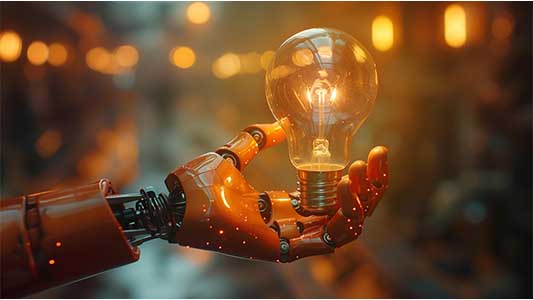
Artificial intelligence is rapidly transforming the design of organic molecules for modern lighting and display technologies, opening up new possibilities for brighter, more energy-efficient, and longer-lasting screens. According to Dr Dalius Gudeika, a researcher at the Faculty of Mathematics and Informatics, Vilnius University, AI is no longer just a supporting tool in materials science but a driving force that allows scientists to explore vast chemical spaces and accelerate the development of advanced OLED technologies used in everyday devices such as smartphones and televisions.
Accelerating the development of smart displays
“One of the fundamental challenges in OLED research is navigating chemical space – a theoretical landscape containing not thousands, but billions of possible molecules, with the total number reaching as high as 10⁶⁰. Finding the few structures within this vast space that can function as bright, efficient, and durable OLED components is a daunting task”, – points out Dr Gudeika.
Until recently, researchers approached this problem manually, synthesising and testing hundreds or even thousands of molecules one by one in the laboratory. They searched for compounds that met strict criteria: efficient light emission, vivid colours, and resistance to environmental factors such as oxygen, moisture, and heat. This process often took years, sometimes even decades, and required significant financial investment. Most attempts failed, as only a small fraction of molecules proved suitable for practical application.
Powered by machine learning and deep learning, AI is now reshaping the principles of organic molecule design. Instead of relying solely on lengthy and costly laboratory experiments, researchers can use AI models to predict key molecular properties with high accuracy. According to Dr Gudeika, these models help identify compounds that emit light more efficiently, produce purer colours, and maintain their performance over time.
This progress accelerates the development of high-quality technologies, making them more accessible to society. More specifically, AI enables faster production of advanced displays, lighting systems, and even certain medical devices for everyday use. For example, AI models can already predict molecular energy levels, which determine how efficiently a molecule emits light or transfers energy in OLED devices.
“Importantly, AI does not merely select suitable molecules – It can generate entirely new ones. Instead of spending countless hours in the laboratory, scientists can identify promising candidates within minutes or even seconds, significantly reducing development time and costs. Generative models act as creative assistants, producing molecular structures tailored to specific needs, such as molecules designed to emit blue light or withstand moisture and heat. These models analyse thousands of structures and their interactions with the environment, allowing researchers to focus on candidates with the greatest practical potential”, – emphasises Dr Gudeika.
A study published in NPJ Computational Materials in 2022 demonstrated how trained AI can support the development of advanced OLED devices. The researchers introduced the DeepHL model, trained on an experimental dataset of 3,026 organic molecules. Using this model, the team developed deep-blue OLED devices with a narrow 412 nm emission band and an external quantum efficiency of 6.58% — the highest performance level achieved at the time. Notably, the design process was 50% faster, and the number of required experiments was reduced by 70%. AI also helped identify molecules with 30% higher energy-transfer efficiency than those used previously.
In 2024, another generative AI model, DeepMoleculeGen, was reported in ACS Central Science. Trained on a dataset of 71,424 molecules and solvent pairs, the model achieved 95% prediction accuracy and increased synthesis yields to 80%, compared with just 10–20% using traditional methods.
How does artificial intelligence create smarter displays?
Dr Gudeika explains that OLED technologies are among the most advanced solutions in modern lighting and display applications, and AI contributes to their improvement in several critical ways. To achieve bright, energy-efficient, and long-lasting displays, organic molecules must be designed with exceptional precision. AI supports the development of specialised materials, such as thermally activated delayed fluorescence (TADF) molecules, which can recover energy that would otherwise be lost.
Designing such molecules requires precise alignment of molecular components. AI-based models can rapidly predict and design structures optimised for specific functions, such as generating blue light in OLED devices – a long-standing challenge due to strict requirements for colour purity and efficiency.
One of the biggest obstacles in OLED technology is the stability of organic molecules. They are highly susceptible to oxygen, moisture, and high temperatures, which accelerate degradation and shorten device lifespans. AI models help address this problem by analysing molecular structures and their behaviour under different conditions. Based on these insights, researchers can introduce targeted modifications, such as adding specific chemical groups or adjusting molecular configurations, resulting in more stable and durable molecules.
AI also helps identify molecules that emit exceptionally pure red, green, or blue light while consuming less energy. This is particularly important for high-resolution TVs and smartphone displays, where colour accuracy is critical. By predicting which molecules will produce the desired colours and optimising their structures, AI helps meet stringent modern display standards while improving energy efficiency.
Another key advantage, according to Dr Gudeika, is AI’s ability to work in tandem with advanced techniques such as quantum chemistry and molecular dynamics. This enables more accurate predictions of how molecules behave within OLED devices, how they interact with surrounding materials, and how they affect overall performance. AI also supports the development of molecules for flexible electronics – displays that can bend, stretch, or be integrated into clothing – where both efficiency and mechanical robustness are essential.
Barriers to AI breakthroughs in chemistry
“Despite its impressive results, AI still faces several limitations. One of the main challenges is the lack of high-quality data. AI models rely on large datasets, yet most existing databases contain only simple, small molecules. In contrast, lighting technologies require complex and highly specialised compounds, forcing researchers to invest significant time and resources in creating targeted datasets”, – notes Dr Gudeika.
Another challenge is molecular synthesis. Even when AI identifies theoretically promising molecules, producing them in the laboratory may be difficult or impractical. Some require rare raw materials or complex chemical processes that are unsuitable for large-scale production. To address this, scientists are increasingly combining AI with automated experimental systems that can evaluate synthesis feasibility in real time, shortening the path from concept to product.
Sustainability represents a third major challenge. Traditional chemical processes can generate hazardous waste and consume large amounts of energy. AI helps mitigate these issues by designing more efficient production methods and biodegradable molecules that reduce environmental impact. By optimising molecular structures, researchers can minimise the use of raw materials and create compounds that degrade naturally, contributing to a more sustainable future.
Lighting that adapts to people and situations
According to Dr Gudeika, the role of AI in developing organic molecules for lighting technologies continues to grow. When combined with quantum chemistry and automated laboratories, AI enables faster progress towards more efficient, flexible, and environmentally friendly devices. Flexible OLED technologies for wearable applications, including smart clothing, medical sensors, and foldable displays, are already becoming a reality.
Looking ahead, AI also opens the door to personalised lighting solutions. Dr Gudeika suggests that future lighting systems could mimic natural daylight to support health, productivity, and sleep quality. Such systems could be used in homes, offices, schools, and hospitals to create more comfortable and stress-reducing environments. AI enables the design of molecules that emit precisely tailored light spectra for specific individuals or situations.
Overall, Dr Gudeika concludes that AI is reshaping the principles of organic molecule design, particularly in areas where lighting technologies face challenges related to efficiency, durability, and sustainability. From processing massive datasets to generating molecules that can realistically be synthesised, AI is becoming not just a tool, but a creative partner in scientific research. While challenges remain, its growing role is set to transform both laboratory science and the way people experience light in everyday life.
